Why a lead tool cares about uptime
For most small B2B businesses the honest answer is a customer, a colleague or nobody. The site was offline for hours, the ads kept running and the contact form sat behind an error page. Nobody noticed until the enquiries dried up.
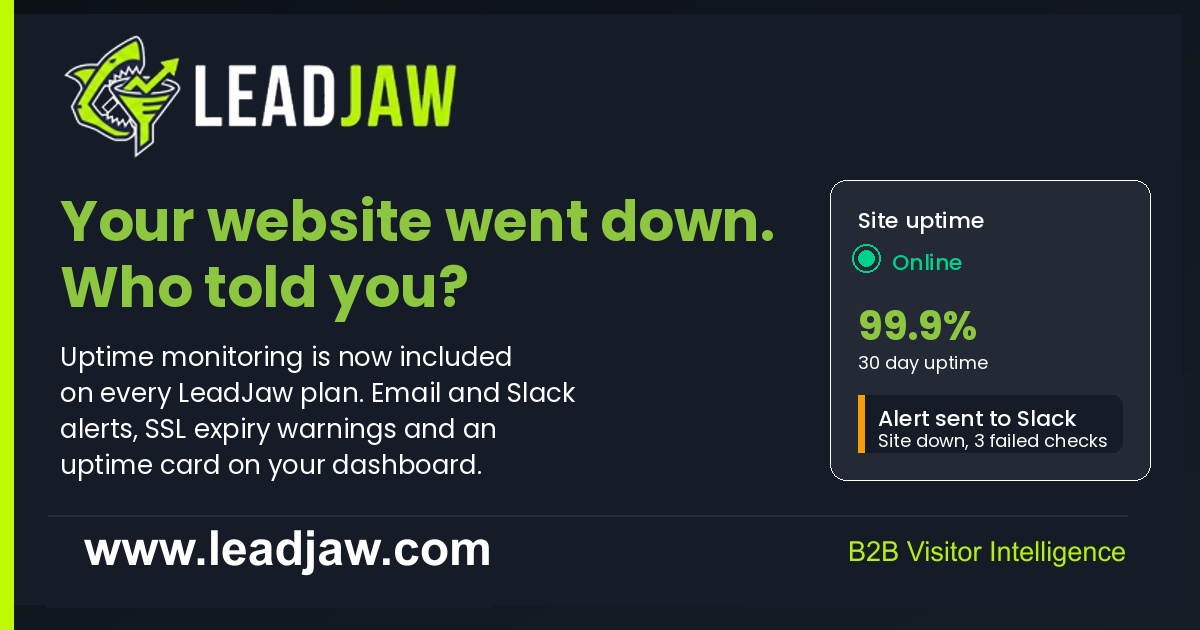
LeadJaw now watches for this. Every account now includes website uptime monitoring. You get email and Slack alerts, an uptime card on the dashboard and SSL expiry warnings. It is live today on every plan at no extra cost.
LeadJaw identifies the companies visiting your website. It shows you which pages they viewed, how they found you and whether they filled in a form. That only works while the site is up.
Think about what happens during an outage. A company clicks your paid search ad and lands on a server error. The page never loaded, so LeadJaw cannot identify them. They cannot fill in a form. They probably will not come back. You paid for the click either way.
Downtime is a lead problem before it is an IT problem. So it belongs in the same place as your lead data.
The overlooked service
Uptime monitoring has been around for years. Plenty of good standalone tools exist. Some are free. The problem is not availability. Small B2B teams rarely set one up.
There is always something more urgent. It means another account, login and dashboard nobody checks. If a developer set it up two years ago, the alerts probably go to an inbox nobody reads. Meanwhile a typical shared hosting plan promises 99 per cent uptime. That still allows more than 80 hours of downtime a year.
Putting it in a tool you already use removes the excuse. If you use LeadJaw to check who visited today, you will see whether the site is up in the same glance.
What is included
Down and recovery alerts. When your site fails three checks in a row, LeadJaw opens an incident. It sends an alert to your account email and your connected Slack channel. When it responds again, you get a recovery alert with the outage duration.
SSL expiry warnings. An expired certificate replaces your site with a browser warning. LeadJaw checks your certificate daily. It warns you 14 days and 7 days before expiry, then again if it lapses. Automatic renewals that keep working never trouble you. The one that silently fails will.
Dashboard uptime card. Current status, 30 day uptime, average response time and days until the certificate expires, next to your visitor stats.
Uptime report. An incident log with start, end and duration for every outage, plus a response time chart. A site that slows down over a few days is often about to go down. The chart shows you the trend.
Digest emails. Your daily or weekly LeadJaw digest now includes an uptime summary.
How often we check
Starter accounts are checked every 5 minutes, Growth every 3 minutes and Pro every minute. We alert after three failures in a row rather than one. A single dropped request is usually a network blip. Three in a row is an outage. This cuts false alarms with little delay.
Checks run from our UK servers and the data stays in the UK with everything else in your account.
Who benefits
Founders and owners who have no IT team and no way of knowing the site is down. Marketing managers paying for traffic that may be hitting a dead page. Sales teams whose pipeline depends on inbound forms. IT managers and agencies who would rather not add another vendor for a job this simple.
What it is not
We want to be clear about scope. LeadJaw monitors the single domain connected to your account from one UK location. It does not provide public status pages, SMS alerts or checks for internal APIs and background jobs. If you run many servers with an on call rota, you need a dedicated monitoring tool. If you run a B2B website and want to know when it goes down, this covers it.
Nothing to set up
If the LeadJaw tracker is on your site, monitoring is already running. There is a toggle on the uptime report if you want to switch it off. No code, no extra account, no extra invoice.
Read more on the website uptime monitoring page, or start a free 10 day trial. See your visitors and your uptime in one dashboard.

Perry Jones writes about B2B sales, marketing technology and revenue operations. He has spent over a decade working with sales teams across SaaS, professional services and managed IT, helping them build repeatable pipeline from inbound and outbound channels.