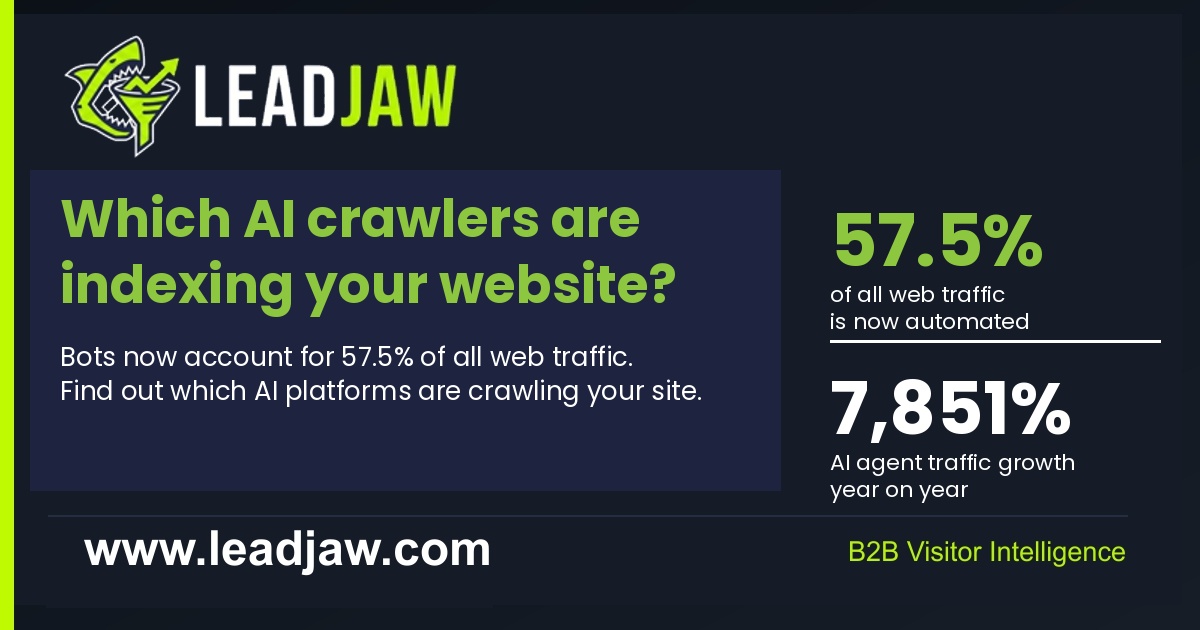
 For the first time, automated traffic now accounts for more than half of all web requests. Cloudflare Radar data published on 3 June 2026 showed bots at 57.5% of HTML page requests versus 42.5% from people, the first time in internet history that automated traffic has exceeded human traffic. Cloudflare CEO Matthew Prince had predicted this crossover would arrive by the end of 2027. It came 18 months early. According to HUMAN Security's 2026 State of AI Traffic report, agentic AI traffic alone grew 7,851% year on year.
A large portion of that automated traffic is AI search crawlers. They visit your site, read your pages and use what they find to answer questions in ChatGPT, Perplexity, Google's AI Overviews and a growing number of other AI-powered tools. If your content is not being indexed by these platforms, you are invisible to a fast-growing channel that your prospects are already using.
The question is: how do you know which AI platforms are crawling your site, how often they visit, and whether your content is actually making it into their indexes?
The main AI crawlers to know about
Each major AI platform sends its own crawler. Here are the ones you are most likely to see in your server logs or visitor analytics.
GPTBot is OpenAI's crawler. It indexes content for ChatGPT and related products. OpenAI publishes its IP ranges, so it is identifiable. If GPTBot is visiting your site regularly, your content is a candidate for appearing in ChatGPT responses.
ClaudeBot is Anthropic's crawler, used to train and update Claude. Like GPTBot, it identifies itself clearly in the user-agent string and respects robots.txt directives.
PerplexityBot crawls for Perplexity AI, the answer engine that has grown rapidly among researchers and technical buyers. Perplexity pulls content in real time to support cited answers, so being indexed here is particularly valuable for B2B content that answers specific questions.
Google-Extended is Google's opt-out crawler for AI training and Google's AI products. It is separate from Googlebot, which handles traditional search indexing. You can block Google-Extended independently without affecting your standard search rankings.
GoogleOther covers a range of Google's non-search crawlers including various product and API requests. It appears frequently in logs and is often the most active Google bot after Googlebot itself.
Beyond these, you will see crawlers from Cohere, Mistral, ByteDance and others, though they are less active on most sites at present.
AI crawlers versus AI agents: an important distinction
Not all automated traffic is the same. There are two types of AI bot worth knowing about, and they have very different implications.
An AI search crawler indexes your content passively. It reads your pages and moves on. You did not invite it and it will return on its own schedule. This is largely positive: it means your content may appear in AI-generated answers.
An AI agent is different. It is an automated browser acting on behalf of a specific user or pipeline, sent to interact with your site rather than just read it. Agents built on tools like Playwright, Puppeteer or Browserbase can scrape pricing pages, pull product data, fill in forms or monitor changes over time. If you see AI agent traffic in your analytics, someone has specifically targeted your site with an automation. That could be a competitor monitoring your pricing, a researcher harvesting data, or a developer testing an integration.
Most website analytics tools do not distinguish between the two. They either lump all bot traffic together or filter it out entirely.
Why AI crawler visibility matters for B2B companies
B2B buyers are increasingly starting their research in AI tools rather than search engines. They ask ChatGPT to compare vendors, use Perplexity to find answers to technical questions and prompt Claude to summarise their options before speaking to sales. If your site is not being crawled by these platforms, you are missing from the conversation at the point where intent is forming.
Knowing which AI platforms are indexing your site also tells you where to focus your content efforts. If PerplexityBot visits regularly but GPTBot does not, your content may be well-suited to cited reference answers but not optimised for the type of content ChatGPT draws on. That is a useful signal for your content strategy.
There is also a practical argument for monitoring AI crawl frequency. A sudden drop in AI crawler visits can signal that your site has been blocked, de-indexed or that a recent content change has made your pages less accessible to automated reading. Catching that early is easier if you have visibility in the first place.
How to see which AI crawlers are visiting your site
There are a few ways to approach this.
Server logs are the most complete source. Every request your server handles is logged, including those from bots. The challenge is that raw logs are not easy to work with. You need to filter by user-agent string, identify the relevant patterns for each crawler and aggregate the results. For most marketing teams, this is not a practical day-to-day option.
robots.txt tells you which crawlers you have chosen to allow or block, but it does not tell you which ones are actually visiting. A crawler may ignore your robots.txt entirely, or your rules may be blocking a crawler you would prefer to allow.
Google Search Console provides some crawl data for Googlebot and Google-Extended, but it only covers Google's own crawlers. It tells you nothing about OpenAI, Perplexity, Anthropic or the growing list of other AI platforms.
Visitor intelligence tools that classify bot traffic by type offer the most practical view. LeadJaw detects and classifies AI crawlers automatically as part of its standard visitor tracking. The bot intelligence layer identifies GPTBot, ClaudeBot, PerplexityBot, Google-Extended and others, categorises them by type and surfaces them in a dedicated view. The AI Visibility widget on the LeadJaw dashboard shows how many times AI platforms have crawled your site in the current period and which platforms were active, with trend data so you can see whether crawler activity is growing or declining.
What to do with this information
Seeing which AI crawlers visit your site is useful context, but the more important question is whether your content is structured in a way that makes it easy for AI platforms to understand and reference.
Content that answers specific questions clearly, uses plain language and is well-organised tends to perform better in AI-generated answers than content optimised purely for traditional search. If you know PerplexityBot is visiting your pricing page but your pricing page does not directly answer common questions, that is a gap worth closing.
You can also use crawler data to validate your robots.txt configuration. If you intended to allow a specific AI crawler but it is not appearing in your logs, check whether your rules are inadvertently blocking it. If you want to block a crawler you consider a threat to your content, confirm the block is actually working.
AI search is not replacing traditional search overnight, but the trajectory is clear. Getting visibility into which AI platforms are indexing your site now puts you in a better position to understand and improve your presence in AI-generated answers as they become a larger part of how B2B buyers research their options.
LeadJaw tracks AI crawler activity automatically alongside human visitor data. Start a 10-day free trial to see which AI platforms are indexing your site.

Perry Jones writes about B2B sales, marketing technology and revenue operations. He has spent over a decade working with sales teams across SaaS, professional services and managed IT, helping them build repeatable pipeline from inbound and outbound channels.