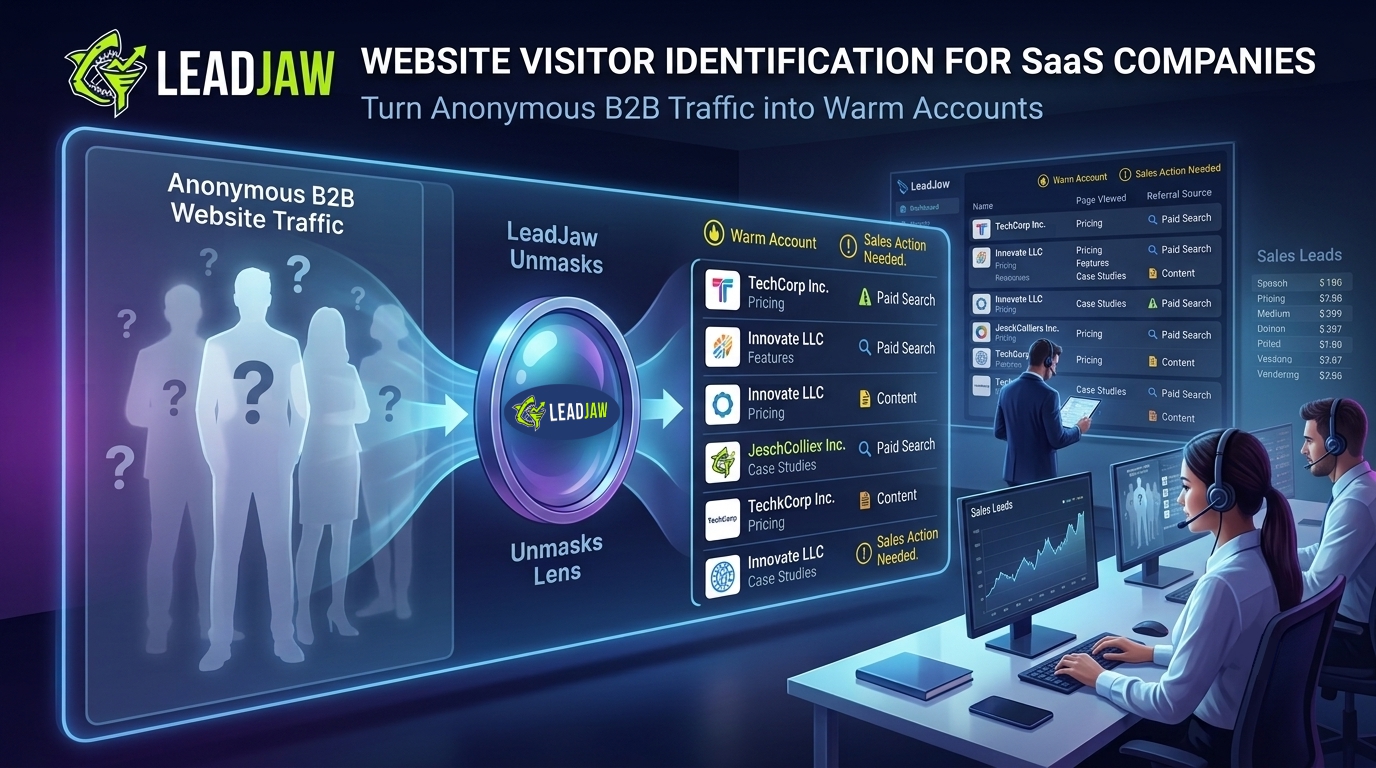
LeadJaw shows SaaS companies which named businesses are visiting their site, which pages they viewed and how they found you. Turn anonymous B2B traffic into a list of warm accounts your sales team can act on before a competitor does.
Most SaaS businesses invest heavily in content, paid search and product-led growth. The traffic arrives. Companies land on your pricing page, browse your features, read your case studies and leave without converting. You see the session in Google Analytics but you have no idea who it was. LeadJaw closes that gap.
How SaaS teams use visitor identification
 Spot warm accounts before they go cold
A company visiting your pricing page three times in a week is showing intent. Without visitor identification, that signal is invisible. LeadJaw surfaces those companies in your dashboard the moment they arrive and can push a real-time Slack alert to your sales team so they can reach out while the account is still active.
For SaaS businesses running outbound sequences, this changes the dynamic entirely. Instead of working through a cold list, your team can prioritise accounts that have already shown interest in the product.
See which channels are driving real business traffic
LeadJaw captures the original traffic source for each company visit, not just the last click. If a target account first found you through a LinkedIn post six weeks ago and came back direct today, both sessions are recorded and attributed. That tells you which channels are actually reaching the companies you want, not just which ones are driving anonymous volume.
For SaaS marketing teams spending on content or paid search, this is the missing layer between campaign analytics and pipeline. You can see whether your investment is bringing in the right companies, not just the right number of sessions.
Match free trial signups to company visits
When a company visits your site and then starts a free trial, LeadJaw connects those sessions. You can see which pages the company viewed before signing up, how many times they visited and where they came from. That context helps your onboarding and sales teams prioritise new trials and understand what drew each account in.
Feed your CRM without manual data entry
LeadJaw also integrates with HubSpot (on the LeadJaw Pro plan). When a named company is identified, LeadJaw can automatically upsert that record into HubSpot so your CRM reflects active inbound interest without anyone manually updating it. Combined with Slack alerts, your team gets notified and your CRM is updated in the same moment.
What SaaS teams can see with and without visitor identification
| Signal | Without visitor ID | With LeadJaw |
|---|---|---|
| Companies viewing your pricing page | Session count only | Named companies with full visit history |
| Accounts returning multiple times | Not visible | Flagged as high intent in dashboard |
| Which channel brought a company in | Last click only in most tools | First-touch source recorded per visit |
| Real-time alerts on target accounts | Not available | Slack alert the moment they arrive |
| CRM updated with inbound activity | Manual entry only | Automatic HubSpot upsert on Pro plan |
| CSV export for reporting | Not available without custom build | Available on Growth and Pro plans |
How LeadJaw fits into a SaaS workflow
Setup takes around five minutes. Add the tracking script to your site via the WordPress plugin, the Webflow OAuth integration or by pasting it directly into your site code. LeadJaw starts identifying company visits immediately and attributes each one to its traffic source.
The dashboard is filterable by company name, industry, country, traffic source, date range and engagement level. You can search for specific target accounts, export results to CSV for reporting or pipe records into HubSpot automatically. Slack alerts can be configured per rule, so your sales team only gets notified about the companies that match your ICP rather than every visit.
For SaaS teams already using Calendly, LeadJaw can match booked meetings to company visit history, giving your sales team context on an account before the call starts.
What LeadJaw identifies and what it does not
LeadJaw identifies business visitors by matching their IP address to a company. It works well for B2B traffic from office networks and corporate connections. It does not identify visitors on consumer broadband, mobile networks or VPNs because those IPs do not map to a business.
For most SaaS companies with a B2B audience, around 20 to 40 percent of traffic will resolve to a named company. The exact figure depends on your audience and the channels driving your traffic. LeadJaw does not make promises about identification rates because every site's traffic mix is different.
The tool is UK-hosted with data residency in the UK, which simplifies GDPR compliance for UK and EU SaaS businesses. It identifies companies, not individuals, which keeps it on the right side of UK data protection rules.
Pricing
LeadJaw is priced per account with no long-term contracts and a 10-day free trial with no payment card required. See current plans and pricing.
Getting started
The quickest way to see what LeadJaw surfaces is to run the free trial on your own site. You will have results within a few hours of adding the tracking script, assuming you are already receiving B2B traffic.
LeadJaw shows SaaS companies which named businesses are visiting their site, which pages they viewed and where they came from. Visitor identification turns anonymous B2B traffic into a prioritised list of warm accounts, with real-time Slack alerts, first-touch attribution and optional HubSpot sync. Setup takes around five minutes and a 10-day free trial available. Get started today.