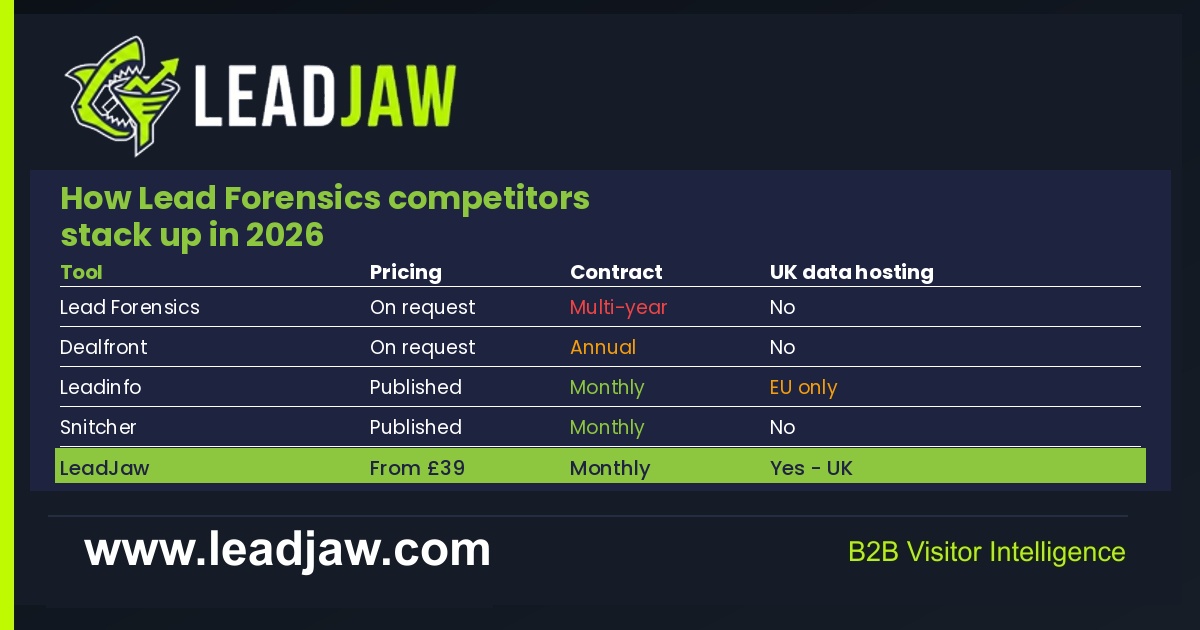
 Lead Forensics is one of the oldest names in B2B website visitor identification. It has also become one of the most searched-for tools to move away from. Long contracts, opaque pricing and a legacy interface have pushed a lot of buyers to look at what else is available.
This article covers the main Lead Forensics competitors worth considering in 2026, what each one does well and where the trade-offs are. The goal is to help you make a clear-headed decision rather than just pick the first alternative that appears in a Google ad.
Why People Look for Lead Forensics Alternatives
Before comparing the options, it helps to understand what usually triggers the search. Most buyers come from one of three situations.
- Contract frustration. Lead Forensics is known for multi-year contracts that are difficult to exit. Buyers who feel locked in start researching alternatives the moment renewal comes up.
- Price shock. Pricing is not published on the Lead Forensics website. Many buyers only discover the cost after a demo, and it is often higher than expected for smaller teams.
- Feature gaps. Some users find the platform does not integrate well with modern stacks, particularly Slack-first teams or businesses built on Webflow or HubSpot.
Whichever applies to you, there are now several credible alternatives with transparent pricing, flexible contracts and modern integrations.
Dealfront (formerly Leadfeeder)
Dealfront emerged from the merger of Leadfeeder and Echobot. It combines website visitor identification with a broader B2B data platform that includes company and contact intelligence.
The visitor identification side works well and the interface is clean. Where Dealfront becomes complicated is positioning. It has evolved into an enterprise product, and pricing reflects that. For smaller B2B teams that just want to know which companies are visiting their site, Dealfront can feel like more than is needed.
It is worth considering if you want an all-in-one prospecting and identification platform and have the budget for it. It is less suitable if you want a focused, affordable tool with a short setup time.
Leadinfo
Leadinfo is a Dutch company that has grown significantly through acquisition, including the purchase of CANDDi in the UK market. It offers solid identification coverage across Europe and a reasonable set of integrations.
Pricing is usage-based and published on the website, which is an improvement over the Lead Forensics approach. The platform is competent and the UI is straightforward.
The main consideration for UK buyers is data residency. Leadinfo processes data in the EU rather than the UK, which matters for organisations that need UK-only data hosting post-Brexit. If GDPR compliance within UK borders is a requirement, that is worth confirming before you commit.
For former CANDDi customers, Leadinfo is the natural successor since it acquired the product, though the platforms are not identical.
Snitcher
Snitcher is a Dutch-built tool that sits at the affordable end of the market. It identifies visiting companies and offers basic filtering and CRM push functionality. For very small teams on tight budgets, it covers the essentials.
The trade-offs are real, though. Enrichment depth is limited compared to more established platforms. First-touch attribution is not a core feature. Integration options are narrower, which can be a problem if your team runs on a specific stack.
Snitcher works as a starting point if budget is the primary constraint. It is harder to justify once a team grows and needs richer data or more flexible alerting.
Salespanel
Salespanel takes a different approach. Rather than focusing purely on company identification from IP data, it combines visitor tracking with lead scoring and pipeline management. It sits closer to a marketing automation tool than a pure visitor identification product.
This makes it useful for teams that want to manage leads inside the platform rather than push data to an existing CRM. The flip side is complexity. If you already have HubSpot or a similar CRM and just want clean company visit data flowing in, Salespanel introduces more moving parts than necessary.
It is US-focused in its market positioning, and pricing is in US dollars. UK and EU buyers should factor in currency and data residency questions before committing.
LeadJaw
LeadJaw is a UK-built B2B visitor identification platform founded in 2025. It identifies which companies visit your website, shows what pages they viewed, how they found you and whether they filled in any forms. Data is hosted in the UK, which gives it a clear GDPR advantage for UK and EU buyers.
A few things separate it from the older tools in this category.
- Transparent pricing. All plans are published at leadjaw.com, starting from £39 per month. No demo required to find out what it costs.
- No long-term contracts. Monthly billing with no lock-in. Cancel any time.
- Real-time Slack alerts. When a target company visits your site, you get notified in Slack immediately, routed to the right channel per your rules.
- First-touch attribution. LeadJaw shows where a visiting company originally came from, not just the last click before they arrived.
- Modern integrations. HubSpot, Slack, Webflow, WordPress and Calendly are all supported. HubSpot and full API access are included on the Pro plan.
- 10-day free trial, no credit card required.
For teams that have outgrown a spreadsheet but do not want to commit to an enterprise contract, LeadJaw sits in a practical middle ground. You can see a direct breakdown of how it compares to the other tools in this list on the LeadJaw vs the Competition page.
How to Choose Between Them
The right tool depends on a handful of practical questions rather than feature lists alone.
Where is your data hosted? If you need UK data residency, that rules out several options immediately. LeadJaw hosts in the UK. Most others process in the EU or US.
Do you need a long-term contract? If flexibility matters, avoid tools that require annual or multi-year commitments upfront. Look for published pricing and monthly billing.
What does your stack look like? If you use HubSpot, Webflow, WordPress or Slack heavily, confirm that the tool integrates properly rather than assuming it does. A native OAuth integration is more reliable than a Zapier workaround.
How big is the team? Larger platforms built for enterprise use often feel heavy for a 10-person sales team. A focused tool that does one thing well is often more useful than a complex platform with features you will never configure.
Is pricing transparent? If a vendor will not publish pricing, expect the number to be high. Transparent pricing is a signal of confidence and fairness.
Most of the tools listed here offer a trial or a free tier. Use them. Real-world performance on your own traffic is more reliable than any comparison article, including this one.
If you are ready to see which companies are visiting your site today, start a free 10-day trial with LeadJaw. No credit card needed.

Perry Jones writes about B2B sales, marketing technology and revenue operations. He has spent over a decade working with sales teams across SaaS, professional services and managed IT, helping them build repeatable pipeline from inbound and outbound channels.