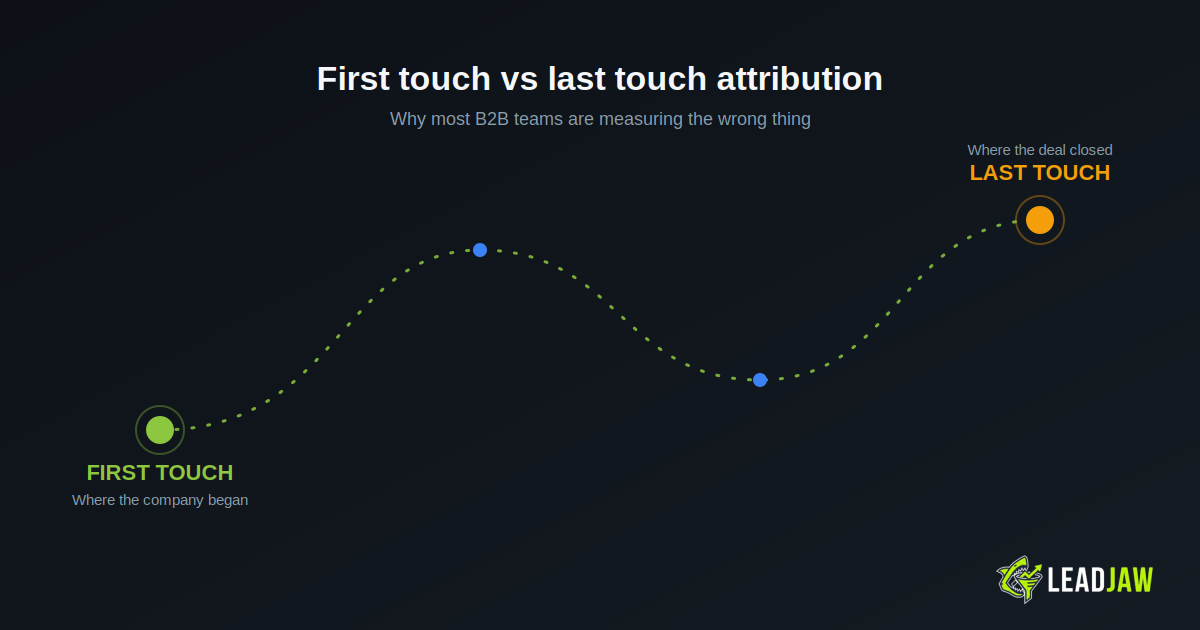
Most analytics tools answer one question well: what happened right before someone converted. Last touch attribution gives credit to the final click, the final campaign, the final search term. It is easy to report on and it is the default view in most platforms, including Google Analytics.
The problem is that last touch tells you almost nothing about how a company found you in the first place. A visitor might land on your site from a LinkedIn ad in March, read a blog post, leave, and not come back until June, this time typing your brand name directly into Google. Last touch attribution credits that June search. The LinkedIn ad that actually introduced the company to you gets nothing.
Why this matters more in B2B
Most B2B buying cycles are long. Multiple people at the same company often visit your site across weeks or months before anyone fills in a form. By the time a deal closes, the path could include a conference mention, a comparison article, a colleague's recommendation, and finally a direct visit to check pricing.
If you only look at last touch, you will keep funding whichever channel tends to close the loop, usually branded search or direct traffic, while starving the channels that actually bring new companies into your pipeline. Over time this creates a strange feedback loop: the channels that introduce your best customers get cut because they never show up as the "converting" source.
What first touch shows you instead
First touch attribution asks a different question: which channel or campaign brought this company to your site for the very first time. This is a much better signal for judging whether your marketing spend is reaching the right audience, because it captures the moment of discovery rather than the moment of decision.
When you can see first touch by company rather than by anonymous session, the picture becomes even more useful. You are no longer asking "which channel drives the most clicks" but "which channel introduces the companies that actually match our ideal customer profile". A campaign that brings in ten visits from small unrelated businesses is not doing the same job as one that brings in three visits from companies the size and sector you actually sell to.
The practical gap
Most attribution tools are built around individual visitor sessions, not companies. This is where the picture tends to break down. A single company might generate a dozen sessions across several people and several devices before anyone submits a form. If each session is treated as a separate, disconnected event, first touch data gets diluted or lost entirely.
Tracking first touch at the company level, rather than the session level, keeps that signal intact. Tools like LeadJaw capture this automatically, you can see how it compares to other visitor identification tools if you are evaluating options. You can see the very first time a company's IP range appeared on your site, what brought them there, and then follow every session after that as part of the same story rather than as unrelated visits.
What to check in your own reporting
A useful exercise is to pull your last twenty converted leads and check two things for each one: what channel gets credit in your current reporting, and what channel actually brought that company to your site for the first time. If the two lists look very different, your budget allocation is probably being shaped by the wrong signal.
This does not mean last touch is useless. It still tells you what nudges a company over the line. But on its own it answers half the question. Pairing it with first touch data gives you the full journey, from the moment a company first noticed you to the moment they decided to act.
If this sounds like critical marketing data you and your team need, start a free 10 day trial of LeadJaw today. For a broader look at how B2B marketing strategy connects to revenue, see our B2B marketing guide.

Perry Jones writes about B2B sales, marketing technology and revenue operations. He has spent over a decade working with sales teams across SaaS, professional services and managed IT, helping them build repeatable pipeline from inbound and outbound channels.